The GTM Revolution Is Half Done


We've already changed our minds once
Three years ago, if you'd told a room of revenue leaders that a spreadsheet-style data tool would rewire how their teams prospect, and that a job title nobody had heard of would show up in thousands of postings, most would have nodded politely and gone back to their pipeline reviews.
Both happened. And here's the part I find most interesting: we barely debated it. The results showed up, and the industry quietly changed how it works.
So I want to ask a question I've been sitting with for months. If we've already accepted that go-to-market has fundamentally changed in one part of the revenue engine, why are we still pretending it hasn't everywhere else?
It's already happening
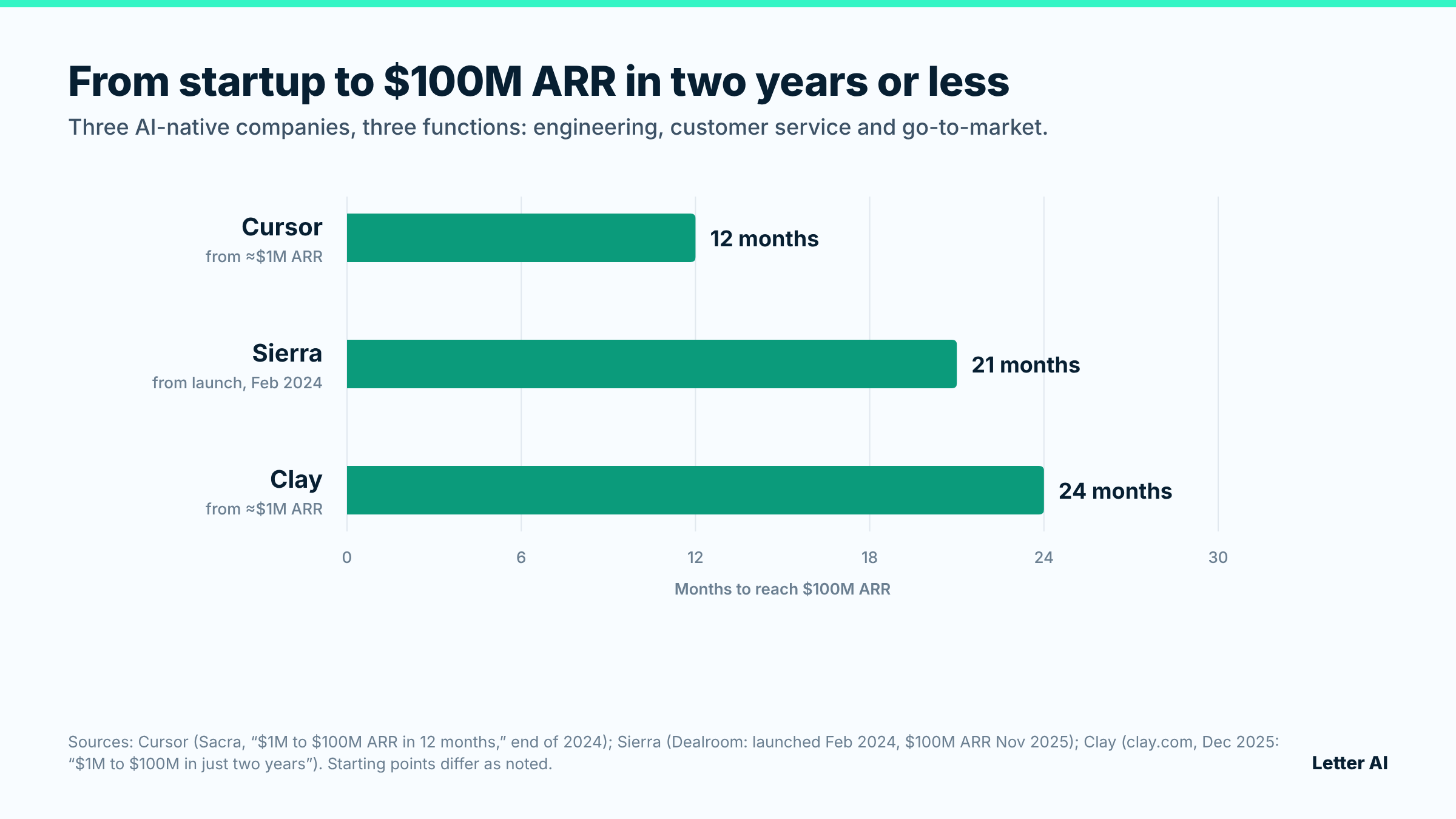
Clay is the clearest example. The company crossed $100M in ARR in December 2025, more than 3.5x the year before, with enterprise net revenue retention above 200%. In September it raised a $115M Series D at a $7.1B valuation, and it now serves more than 17,000 customers.
The numbers are impressive, but they aren't the real story. The real story is what customers built around the product. Clay coined the term "GTM engineer" in 2023. One analysis found postings for the role grew 205% year over year, reaching roughly 3,000 open roles in early 2026. Ninety-five percent of them mention AI, LLMs, or agents. Only about two-thirds even name Clay.
Think about what that means. Companies rewrote job descriptions, moved budget, and created a career path around an AI-native way of working, all in about two years. That isn't a feature adoption curve. That's an industry accepting that the old way is over.
And Clay isn't alone.
Look at engineering. Cursor crossed $100M in ARR in January 2025. By mid-2026, its annualized revenue was roughly $4B, and in August, SpaceX closed its $60B acquisition of the company. Developers didn't wait for their old tools to add an AI tab. They moved to a product built around AI from day one.
Look at customer service. Sierra hit $100M in ARR in November 2025, seven quarters after launching, and now serves more than 40% of the Fortune 50. It doesn't even charge per seat. Customers pay when its agents actually resolve an issue. That's not a new feature. It's a new business model, because it's a fundamentally different product.
Three functions. Three AI-native companies. The same pattern every time: once people saw hours come back and outcomes improve, the debate was over.
Why we've only accepted half of it
Look at where that acceptance happened, though. We embraced AI where the return was easy to count: accounts enriched, emails sent, tickets closed.
We've been far slower where the work sits closer to people: coaching, readiness, content, the deal itself. Those are the parts of GTM we're most protective of. They're also where legacy vendors are most entrenched.
Some of that hesitation is reasonable caution. A lot of it is structural: multi-year contracts, admins trained on systems built a decade ago, and the very human instinct not to rip out something we just finished implementing.
Enablement is where the gap is widest
I see this most clearly in enablement. It's the reason my co-founder Armen and I started Letter AI.
For a decade, enablement platforms were built around repositories, folders, search, and destinations reps had to remember to visit: learning paths, content libraries and certifications. Those things still matter, but they were never the point.
Ask any rep what they do the night before a big call. They don't open the enablement portal. They Slack a colleague, dig up an old deck, or wing it.
It's not that reps don't care. The system wasn't built for how they work. In Salesforce's 2026 State of Sales report, 52% of sales reps said traditional enablement doesn't give them the skills they need.
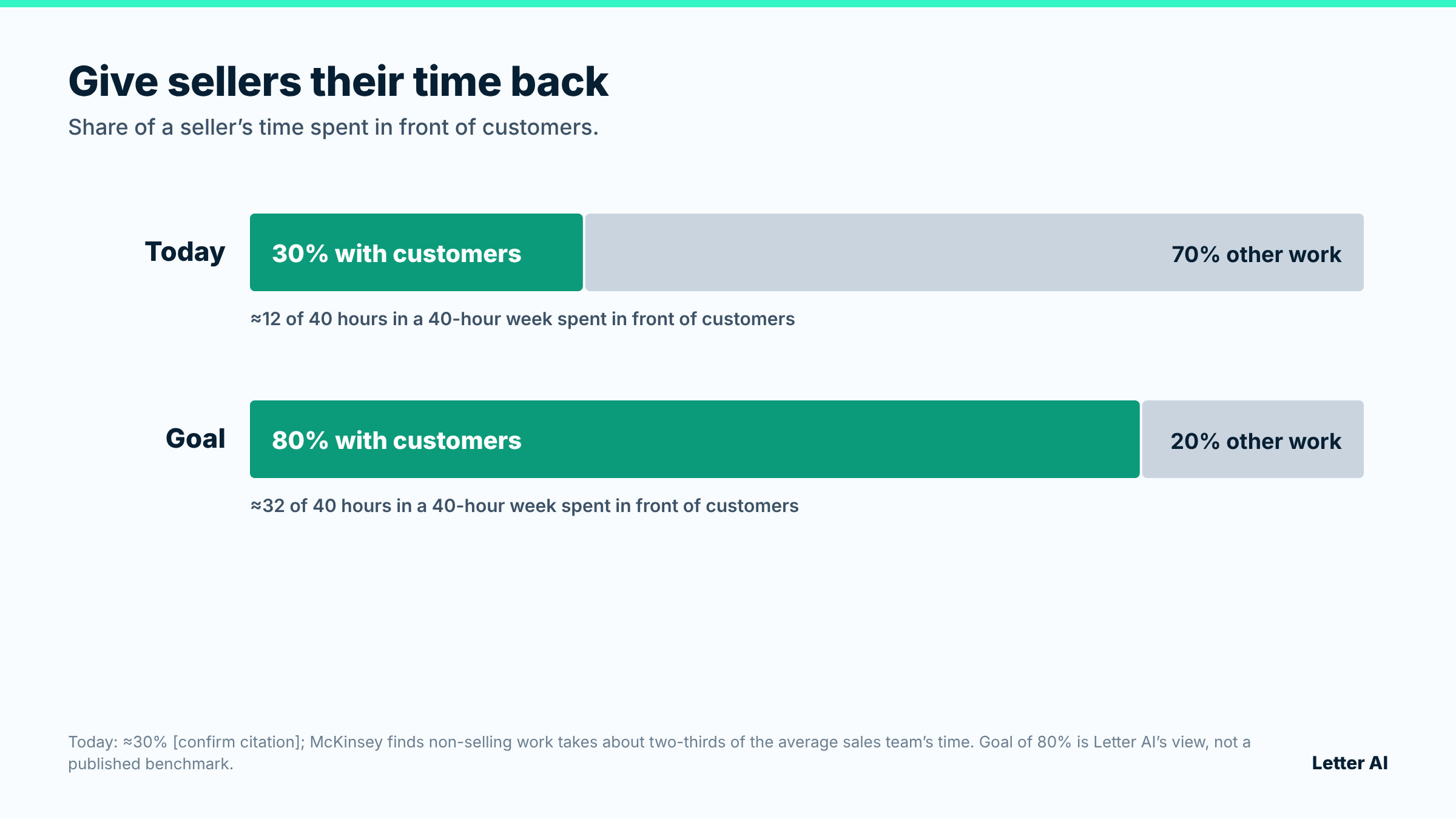
The point of enablement is helping revenue teams win more, win better, and win faster. Yet McKinsey found that non-selling activities still consume two-thirds of the average sales team's time. Today, sellers spend roughly 30% of their time in front of customers. It should be 80%.
Getting there won’t come from another training program. Think about the hour a rep spends the night before a big call, pulling current pricing, hunting for a case study that fits this buyer, and rereading competitive notes. That hour should be ten minutes. And a rep who wants to rehearse a tough pricing conversation shouldn’t have to wait for the next sales kickoff. They should be able to do it tonight.
Enablement belongs inside the deal. And it should be measured in time returned to sellers, not course completions or content views.
There's an irony here. Many companies now run the top of the funnel on AI-native infrastructure that generates more pipeline than ever. Then they hand that pipeline to reps who are prepared with tools designed for 2012.
This is about more human selling, not less
I want to be clear about why this matters, because the AI conversation often gets it backwards.
Buyers still buy from people they trust. Discovery, judgment, empathy, reading the room: that's where deals are won, and it's where the magic has always happened. No model replaces it.
What AI can do is protect it. Every hour we take off a rep's plate in searching, formatting, and preparing is an hour they can spend with a customer. McKinsey found that leading sales organizations freed up about 20% of their teams' capacity through automation, and they're now layering AI on top of that. The GTM engineer didn't eliminate sellers. It freed them from work that never needed a human. Enablement should do the same.
Built with AI is not the same as bolted on
Here's the uncomfortable truth for our industry: most of the big GTM platforms of the last 10 to 20 years can't get us there by adding features.
AI-native companies are different by design. The intelligence is the product, they ship weekly and they're built to measure outcomes rather than usage. Clay didn't win by adding AI to an old data provider. It won because it was built around a new way of working from day one, without inheriting the architecture or assumptions of what came before. The same is true of Cursor and Sierra.
AI-native tools aren't finished, either. Clay's own pricing overhaul this year frustrated some smaller customers. But growing pains are what a new category looks like. They're not a reason to stay in the old one.
The clock runs faster now
Clay went from roughly $1M to $100M in ARR in about two years. Cursor went from $100M to roughly $4B in about 18 months. That's the pace of this market now. What felt cutting-edge six months ago is table stakes today.
In that environment, signing a five-year commitment to a legacy platform is a bet that nothing important will change. In prospecting, that bet has already lost.
What I'd ask of GTM leaders
- Name where you've already accepted AI-native tools, and ask honestly why the rest of your org hasn't followed.
- Make time returned to sellers a top-line metric across the whole revenue engine, not just outbound.
- Ask every vendor one question: is AI your foundation or your feature? Then ask how often they ship.
- Redesign roles the way the GTM engineer was designed. What would enablement, RevOps, or frontline management look like if you built it today?
- Replace 12-month evaluations with 30-day pilots.
We've already proven we can change. We did it at the top of the funnel, in about two years, with very little fuss. The question isn't whether AI-native GTM works. It's why we're only using it for half the job.
The best sellers have always been the most human ones. For the first time, we can give them the time to be.

Learn more about Letter AI
Security and privacy are top of mind for you, so they are top of mind for us. We are secured by industry-leading security frameworks and never use your data to train our models.
